Home > Free Resources > Study Resources Library > Animals A to Z (Y6 & Y7)
96 Animal Names A to Z - Free Printable PDF Word List for Years 6 and 7
- RRP:
- FREE
- Format:
- Printable PDF
- Pages:
- 4
- UK English
No email required.
Overview
From aardvarks & hermit crabs to jellyfish & Komodo dragons, how many of these 96 animals can your child name?
ABOUT THIS FREE RESOURCE
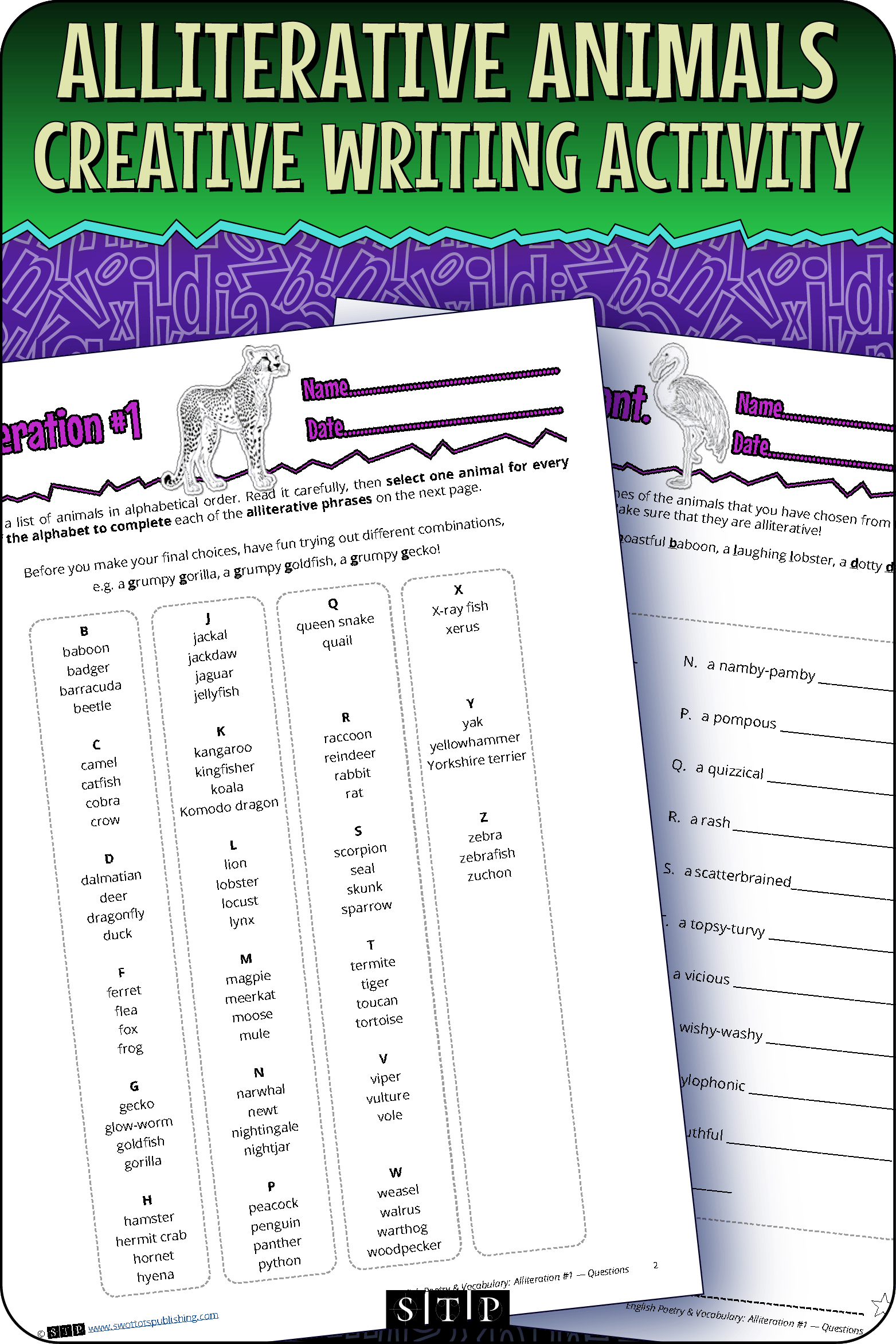
Designed to be used as a printed word mat or poster or as a digital resource, this free vocabulary PDF provides 96 animal names arranged alphabetically, ranging from the familiar (e.g. beetles, hamsters, and penguins) to the less so (e.g. impalas, quails, and warthogs).
CONTENTS AT A GLANCE
- 96 distinct animal names, including those beginning with Q, U, and X
- A mix of closed, hyphenated, and open compound nouns
- Four entries per letter on average
- Alphabetical organisation for easy reference
- Full-colour and greyscale printing available
SUITABLE FOR
- General knowledge and vocabulary expansion, particularly in science
- Preparation for 11+ exams, specifically Verbal Reasoning and English papers
- Use in the classroom or at home
- Parents and teachers who want a concise, self-contained learning resource
SUGGESTED AGE GROUPS
- Ages: 10-11, 11-12
- Years: Year 6 and Year 7
- Key Stages: Upper KS2 & Early KS3
LEARN MORE
To learn more about this resource's learning objectives and outcomes, seasonality & age range, please see this resource's FAQs.
To learn more about the specific features of this resource and suggestions about how to use it, please see our handy 96 Animal Names A to Z FAQs.
96 ANIMAL NAMES A TO Z - LEARNING OBJECTIVES, SEASONALITY, & AGE RANGE FAQs
WHAT ARE THE LEARNING OBJECTIVES & OUTCOMES OF THIS RESOURCE?
This list of words aims to extend students’ knowledge of animal names. Although children in Year 6 and Year 7 will already know dozens of animals, there will be ones they have not encountered yet.
Beyond expanding students’ general knowledge, there are two further benefits: improving the vividness and precision of their writing. Compare the following pair of sentences:
PAIR A
- The large bird watched them from the branches.
- The vulture watched them from the branches.
Here, 'vulture' in the second sentence conveys far more than 'large bird' in the first through the association of vultures with danger, scavenging, and death.
Now compare this pair of sentences:
PAIR B
- The python’s fatal venom killed him.
- The cobra’s fatal venom killed him.
Here, the first sentence is incorrect since pythons do not kill through venom; they kill by constricting their prey. Once students know the differences between animals, they can choose correctly among them.
Having a broader knowledge of animals means, therefore, that students are far better equipped to produce writing that is both accurate and rich.
IS THIS AN EVERGREEN OR SEASONAL RESOURCE?
This is an evergreen resource that you can used at any point in the school year.
That said, you may find it particularly helpful in the spring when animals tend to come up in conversation. You may also find the list useful in the summer during the lead-up to the autumn 11+ examinations (see below for more details).
IS THIS RESOURCE SOLELY FOR THE AGES LISTED ABOVE?
The years and ages listed above are intended as recommendations only; please feel free to use this resource in any educational context that suits your needs.
96 ANIMAL NAMES A TO Z - USING THIS RESOURCE FAQs
I AM A PARENT: DO YOU HAVE ANY OTHER USAGE SUGGESTIONS FOR ME?
The list is a good starting point for a range of extension activities. Here are a few suggestions:
- Excursion Companion. If you are planning a trip to a zoo, wildlife park, or nature reserve, you could use this list in three different ways. Before a trip, use the list to prime your child’s curiosity about the animals they might see. During a visit, use the resource as a reference point or checklist. After your excursion, used it as a prompt for a writing project or a discussion.
- Compound Nouns Mini-Library. Go through the names and identify all three types of compound nouns illustrated by the list: closed, hyphenated, and open compound nouns (e.g. dragonfly, glow-worm, and hermit crab). This is helpful for a session on nouns and their types.
- Themed Sub-Lists. Read through the list with your child and select animals to create your own shorter, themed sub-lists. Such lists could include sea creatures, UK native species, or nocturnal animals.
- Creative Writing Spark. Use the listed animals as a quick brainstorming aid for a creative writing session. If your child wants to give a character an animal companion; or set a scene in a particular habitat; or decides that their main character should be an animal, having 96 names to browse is a useful starting point.
ARE THESE WORDS SUITABLE FOR 11+ PREPARATION?
Yes. Animal vocabulary appears in 11+ papers in several ways, and this list is helpful when you are preparing your child for both Verbal Reasoning and English tests.
In Verbal Reasoning papers, animal names appear in the questions that rely on general knowledge, especially analogy questions and odd-one-out questions.
But animal names also appear, perhaps less obviously, in letter-pattern questions.
In such questions, students are asked to identify a word hidden within another word, or to add and remove letters to make new words. These processes become easier and faster to answer if students know – or are at least familiar – with these names. Several names on this list contain shorter words. For example: ‘camel’ contains ‘came’; ‘flea’ contains ‘lea’; and ‘impala’ contains ‘imp’.
In English papers, a wide animal vocabulary supports faster and more confident reading comprehension. Students who understand a word like ‘narwhal’, ‘gecko’, or ‘nightjar’ in an unseen passage will not lose time to inferring the meaning of the word.
HOW DO I USE THIS RESOURCE IN ITS PRINTED FORMAT?
There are several ways to use the printed version.
- Word Mat. Keep it on hand as a desk-side reference for your tween to consult while they're working on a piece of writing or reviewing a text.
- Page in Personalised Lexicon. If you already have a ring binder or a folder of word mats, or word lists, you may wish to add this sheet to it.
- Poster. Hang it as a poster as part of a word wall or learning wall display for easy reference in your classroom or at home.
HOW DO I USE THIS RESOURCE IN ITS DIGITAL FORMAT?
As with the printed format, the digital format of this resource can be used in various ways.
- A Digital Word Bank. The PDF can be opened on screen and kept open alongside the document your tween is working in. This works particularly well for laptop-based writing tasks.
- A Digital Vocabulary Check-List . With most PDF readers, your tween can also use the annotation tools to highlight words they want to remember, or tick off entries they've already learned or just used in an exercise.
- Classroom Projection Resource. If you are a teacher and want to use this resource in your classroom, consider projecting this PDF onto an interactive whiteboard during a creative writing lesson to use for whole-class brainstorming or group work.
Note: Given the vibrant nature of the full colour version of this resource, it works particularly well in its digital format.