Home > Free Resources > Worksheets & Activities > Indirect & Direct Speech (Y5 & Y6)
KS2 Indirect & Direct Speech Worksheets with Answers – Free Printable PDF for Years 5–6
- RRP:
- FREE
- Format:
- Printable PDF
- Pages:
- 8
- UK English
No email required.
Overview
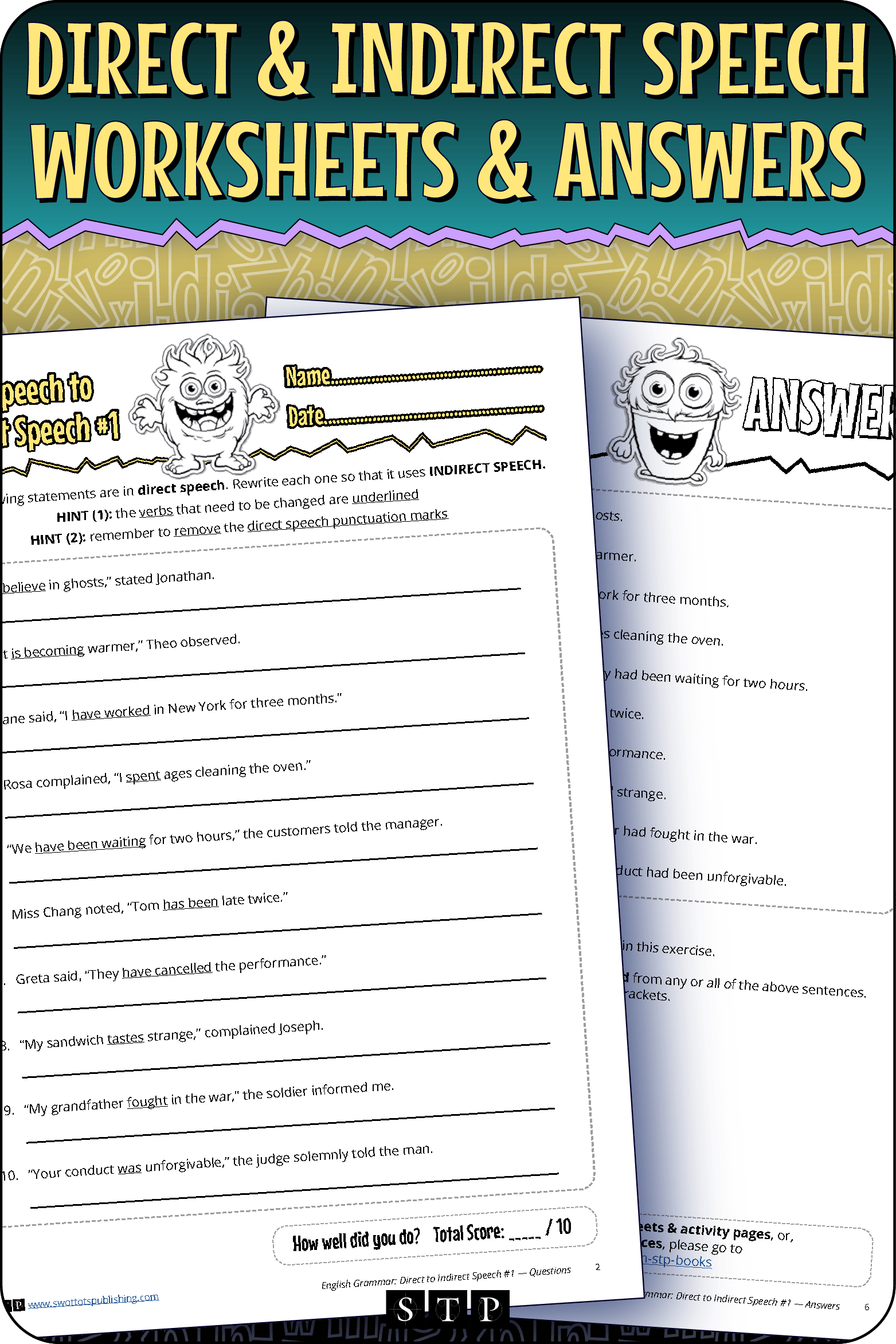
Help develop your child's ability to switch from indirect speech to direct speech with these free printable sentence transformation exercises.
ABOUT THIS FREE RESOURCE
This printable PDF provides children with targeted indirect speech to direct speech practice. Children rewrite 10 varied indirect speech sentences as direct speech.
The resource includes two differentiated versions: Version 1 highlights the verbs needing change and prompts students to use direct speech punctuation; Version 2 provides the core task only for a greater challenge. Full answers are supplied.
Quick Notes for Parents & Teachers outline the learning objectives, explain the two versions, and map the sections of the resource.
The resource includes two printing options for the exercises: colour or ink-friendly greyscale.
CONTENTS AT A GLANCE
- 10 sentences to change from indirect speech to direct speech
- Two versions: with hints (underlined verbs and punctuation usage reminder) and no hints
- Full answers
- Quick Notes for Parents & Teachers
- Colour-accented and ink-friendly greyscale printing options available
- Links to further free resources
- A4 printable PDF
SUITABLE FOR
- Grammar & speech punctuation practice and revision
- Classwork, homework, tutoring, or home learning
- Quick, targeted checks before SATs, mock exams, or other assessments
- Parents and teachers who want targeted, self-contained practice materials
SUGGESTED AGE GROUPS
- Ages: 9-10, 10-11, 11-12
- Years: Year 5, Year 6, & Year 7
- Key Stages: Upper KS2 & Early KS3
LEARN MORE
To learn more about this resource's differentiation, learning objectives & outcomes, seasonality & age range, please see this resource's FAQs.
To learn more about indirect and direct speech, please see our quick Indirect and Direct Speech FAQs.
DIFFERENTIATION, LEARNING OBJECTIVES, SEASONALITY, & AGE RANGE FAQs
DIFFERENTIATION
What is a Differentiated Resource?
A differentiated resource is one that provides the same exercise in two distinct versions. Each version has its own format and separate instructions.
Why Differentiate?
The material is differentiated to accommodate children and students with a range of abilities and strengths. The differentiation also means that the exercise can be used more than once - with Version 2 providing an extra (or subsequent) challenge.
How is this Resource Differentiated?
Version 1 provides children and students with guided practice. The verb that needs to be changed is underlined, and children and students are reminded that they need to use direct speech punctuation.
Version 2 gives children and students the opportunity to practise independently. They are not given any help beyond the exercise's core instructions.
LEARNING OBJECTIVES & OUTCOMES
These exercises help children and students focus on the verb that needs to be shifted one tense forward—a key element in transforming sentences from indirect speech to direct speech. These exercises also reinforce the need to include direct speech punctuation marks and to use the punctuation correctly.
By enhancing these skills, children and students are better equipped to convert sentences from indirect speech to direct speech (a common Year 6 SATs task) and to make their own writing more precise.
SEASONALITY
You can use this resource at any point during the year. It may be particularly useful to children and students when they are first learning about indirect and direct speech, or as a targeted revision tool before mock tests or exams.
AGE RANGE & SUITABILITY
Kindly note that the years and ages listed above are intended as recommendations only. Feel free to use this resource in any educational context that is appropriate to your needs.
INDIRECT AND DIRECT SPEECH - FAQs
WHAT ARE DIRECT AND INDIRECT SPEECH?
In a nutshell, we use the terms ‘direct speech’ and ‘indirect speech’ to describe the two ways we have to share what people say.
When we describe speech as direct, this means that we are repeating the exact words that a person said.
And, when we write a person’s exact words down, we use quotation marks (also called speech marks or inverted commas) to show these exact words.
- Sarah said, "I love ice cream!"
- “My brother is eating jam,” declared Leah.
- Rob noted, "I ate breakfast."
- “We were visiting Manchester,” announced the twins.
- Gina asked, “What time is the match?”
- “Has Julia arrived?” inquired Rita.
- Hal wondered, “Where are my keys?”
- “Are there any cucumbers left?” Zane asked.
On the other hand, when we describe speech as indirect, this means that we are conveying the meaning of what another person said, but we are NOT using their EXACT words.
In this case, we
- Do not use quotation marks
- Often need to change
- pronouns (words like “I”, “we”, “you”)
- verb tenses
- the order of the words (with questions)
- Also often need to add words like “that”, “if” or “whether”
So, if we change the previous examples of direct speech to indirect speech, we find the following:
- Sarah said that she loved ice cream.
- Leah declared that her brother was eating jam.
- Rob noted that he had eaten breakfast.
- The twins announced that they had been visiting Manchester.
- Gina asked what time the match was.
- Rita inquired if Julia had arrived.
- Hal wondered where his keys were.
- Zane asked whether there were any cucumbers left.
Note: As you have probably already noticed, converting questions from direct speech to indirect speech is not the same as converting statements. To keep this guide clear and concise, it focuses chiefly on statements.
ARE THERE QUICK WAYS TO TELL DIRECT SPEECH AND INDIRECT SPEECH APART?
Once you know what their chief characteristics are, direct speech and indirect speech are quite distinctive:
- Direct Speech:
- Uses the speaker's exact words
- Always uses quotation marks ("...")
- Often includes a "reporting clause" like "he said" or "she asked" that introduces the speech
- Punctuation rules: Commas or other punctuation usually separate the reporting clause from the quoted speech (e.g. He said, "Hello.").
- Indirect Speech:
- Reports the meaning of what was said, not the exact words.
- Does NOT use quotation marks.
- Often uses the conjunction 'that' (or ' 'if' or 'whether' with questions)
- Often requires changes to pronouns (e.g. 'I' becomes 'he' or 'she')
- Often requires changes in verb tenses to reflect the shift in time or speaker
WHY DO WE NEED DIRECT SPEECH AS WELL AS INDIRECT SPEECH?
Both direct and indirect speech are useful for different reasons:
Direct speech makes writing livelier and more immediate. It lets the reader “hear” a person’s (or character’s) voice and feelings. It’s great for dialogue in stories.
Indirect speech is useful when you want to summarise what someone said, or when the exact words aren't as important as the message. It's often used in news reports, essays, or when retelling a long conversation.
* * * * *