Home > Free Resources > Quick Guides for Parents > Antonyms (KS2 & KS3)
UNDERSTANDING ANTONYMS: A QUICK GUIDE FOR PARENTS (KS2 & KS3)
What are Antonyms?
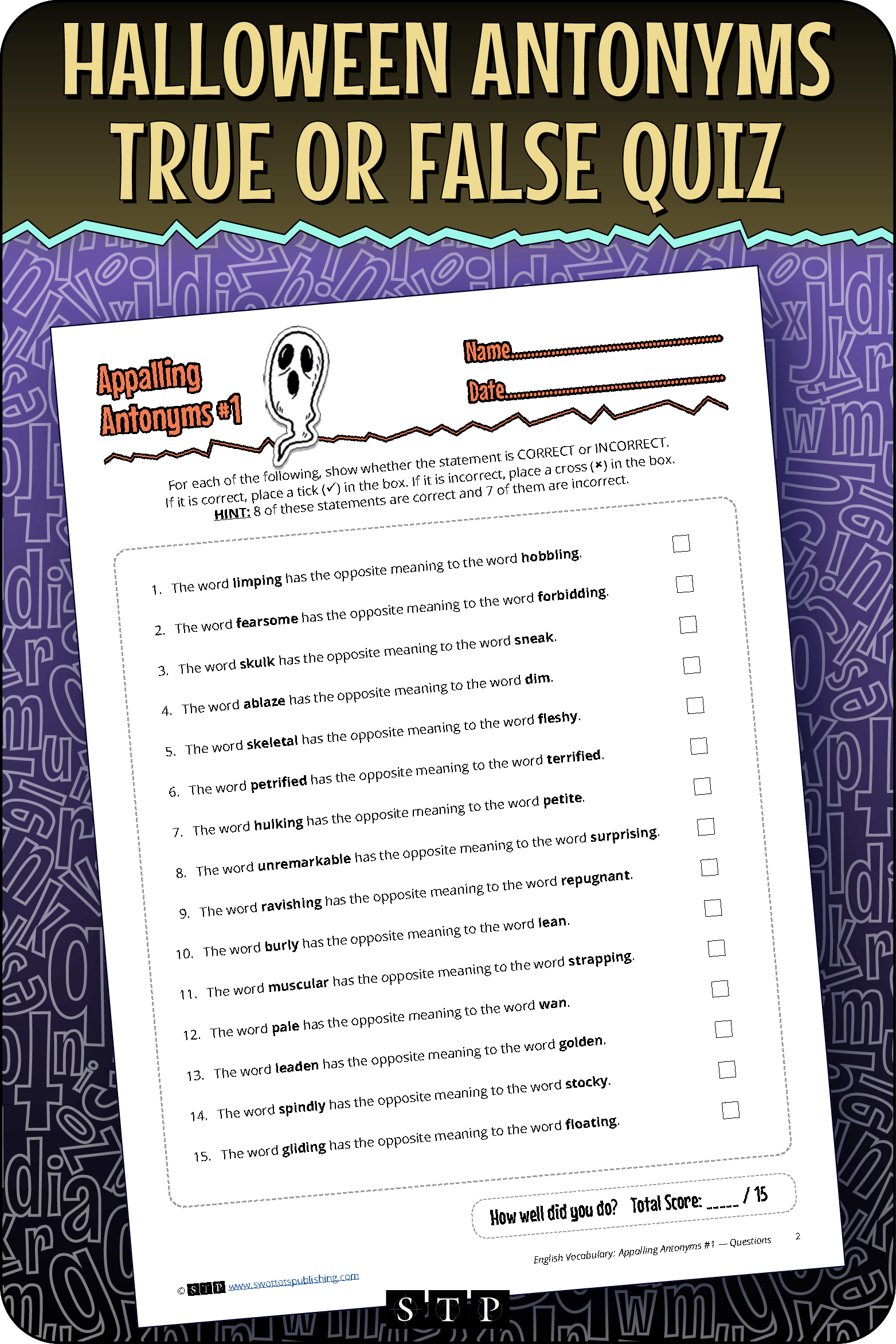
Antonyms are words with opposite meanings. They help us show contrast clearly and efficiently.
Examples of Common Antonyms:
- hot ≠ cold
- up ≠ down
- big ≠ small
- happy ≠ sad
- fast ≠ slow
* * * * *
Why are Antonyms Important?
Antonyms are valuable tools for young learners for several reasons:
Improving Writing:
- Create Contrast: Antonyms allow writers to highlight differences and create tension or emphasis. For example, "The room was dark, save for the sliver of light peeking through a gap in the curtains."
- Add Clarity: Knowing opposites helps children choose words more precisely to say exactly what they mean.
Aiding Comprehension:
When reading, recognising antonyms helps children understand opposing viewpoints or changes in a narrative.
* * * * *
Where Do We Find Antonyms and How Do We Learn Them?
As with synonyms, learning antonyms is an ongoing journey, but, once again, there are some targeted strategies you might find helpful:
1. Learning About the Power of Prefixes:
This is a direct way for children to learn antonyms. By introducing them to common prefixes that create antonyms, children can quickly expand both their knowledge of specific antonyms and their ability to form (or predict) more in the future. Some of the most common prefixes that form antonyms are as follows:
- un- (e.g., unhappy, unkind)
- dis- (e.g., dislike, disagree)
- in-, im-, il-, ir- (e.g., invisible, impossible, illegal, irregular)
Please remember that while prefixes are used with different word classes, they rarely change the class of the base word. This being English, however, there are a few exceptions to this, such as:
- a- (e.g., blaze noun / ablaze verb)
- be- (e.g., witch noun / bewitch verb)
- en- (e.g., joy noun / enjoy verb)
2. Exploring Words in a Thesaurus or Dictionary:
Many thesauruses list antonyms in addition to synonyms. Standard dictionaries also provide definitions that can help identify opposites.
3. Other Active Learning Strategies:
Learning is not restricted to books or screens. There are many ways - including games - that actively encourage and foster children's learning in a variety of settings.
- Pairing Game / Memory Game: Create flashcards with words & their antonyms. Children can match antonym pairs.
- "Opposite Day": Challenge children to use antonyms in conversation for a short period (e.g., "Good morning" becomes "Bad evening").
4. Read Widely:
Encourage your child to notice words that describe contrasting ideas in stories, non-fiction books, and even conversations.
* * * * *
Are There Tricky Antonyms?
Yes, just like synonyms, antonyms can sometimes be tricky.
- Degrees of Opposite: Some words have a clear, direct opposite (like "on" and "off"), while others might have several possible antonyms depending on the nuance. For instance, an antonym for "brave" could be "cowardly" or "fearful".
- Context Matters: Again, as with synonyms, context is key. The antonym that is chosen must fit the context of the sentence.
- Example (1):
- The moon bathed the night in silvery light.
- The moon bathed the day in silvery light.
- In the context of the moon, the antonyms night and day cannot simply replace each other.
- Example (2):
- "Argh! I forgot to switch the dishwasher off!" she groaned.
- "Argh! I forgot to switch the dishwasher on!" she groaned.
- In the context of a dishwasher, using either of the antonyms off or on is perfectly acceptable.
- Words Without Clear Opposites: Some words, particularly concrete nouns or proper nouns, might not have a simple antonym. What, for example, is the opposite of silk or London?
* * * * *
What Types of Words Can Be Antonyms?
Antonyms exist for many types of words:
- Adjectives (describing words):
- tall ≠ short
- bright ≠ dim
- Verbs (doing words):
- start ≠ finish
- love ≠ hate
- Nouns (naming words):
- friend ≠ enemy
- victory ≠ defeat
- Adverbs (describing actions):
- quickly ≠ slowly
- loudly ≠ quietly
- Prepositions (connective words)
- on ≠ off
- above ≠ below
- inside ≠ outside
* * * * *
Are There Rules for Antonyms?
While there are some "rules" for creating antonyms with certain prefixes (like using im- before words beginning with b, m, or p, and using ir- for words that begin with r), there isn't a general set of rules to follow.
Like synonyms, when using antonyms, the one thing your child should always do is think about what it is exactly that they wish to express to ensure that they choose the best word for the context.
* * * * *