Home > Free Resources > Quick Guides for Parents > Grammatical Moods (KS2 & KS3)
GRAMMATICAL MOODS: A QUICK GUIDE FOR PARENTS (KS2 & KS3)
WHAT IS A GRAMMATICAL MOOD?
Essentially, a verb’s mood tells you why the sentence is being said; it tells us what the speaker’s attitude or purpose for saying something is.
Put slightly differently, mood refers to the way we use a verb to show if we are
- stating a fact
- giving an order
- asking a question
- expressing a wish
This is different to a verb's tense which tells you when an action happens (past, present, future).
In English, we primarily use three main grammatical moods:
- the Indicative
- the Imperative
- the Subjunctive
* * * * *
WHAT IS THE INDICATIVE MOOD?
The Indicative Mood is the most common mood. We use it to state facts, express opinions, or ask questions about actual events. It's the mood of reality and certainty.
Examples:
- The sun rises in the east. (A statement of fact.)
- I am going to the park. (A statement about an actual event.)
- He believes it will rain tomorrow. (An expression of opinion.)
- Did you finish your homework? (Asking about an actual event.)
- The cat slept all day. (A statement about a past event.)
* * * * *
WHAT IS THE IMPERATIVE MOOD?
The Imperative Mood is used to give commands, make requests, or offer advice. It is the mood of orders and instruction. The subject ("you") is usually implied and not stated explicitly.
Examples:
- Close the door. (A command.)
- Please pass the salt. (A polite request.)
- Be careful! (A warning.)
- Take a break from your screen. (A piece of advice.)
- Do not walk on the grass. (A negative command.)
* * * * *
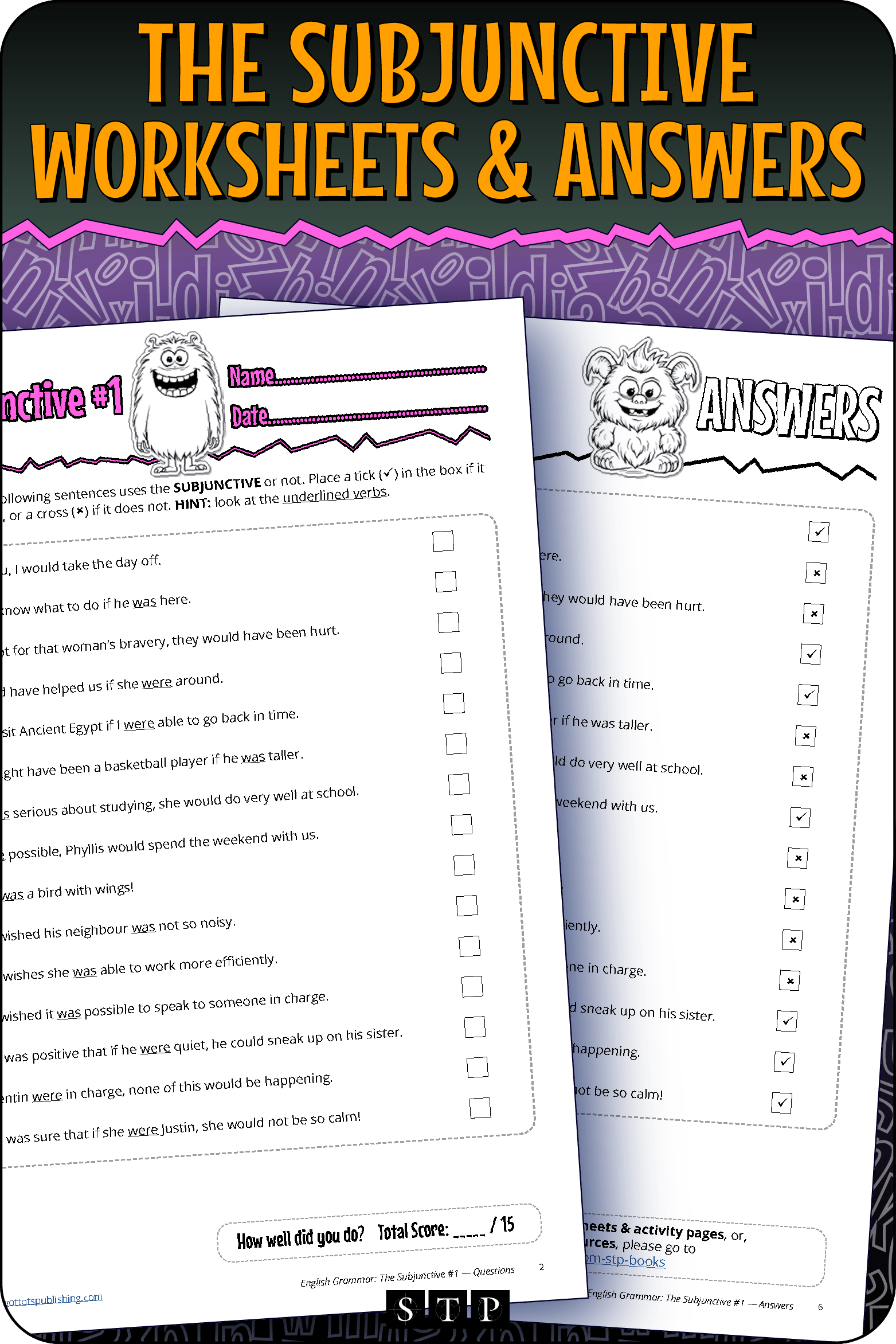
WHAT IS THE SUBJUNCTIVE MOOD?
The Subjunctive mood is used to talk about things that are not factual or certain. It's the mood of unreality—for expressing wishes, suggestions, possibilities, or imaginary situations.
Examples:
- I wish I were a superhero. (An imaginary situation; I am not a superhero.)
- It is essential that he be here on time. (A suggestion or requirement.)
- If she were taller, she could reach the top shelf. (A hypothetical situation.)
- I demand that the package be sent immediately. (A formal demand.)
- He suggested that we eat dinner early. (A suggestion.)
RELATED WORKSHEETS & QUICK GUIDES
Subjunctive Worksheets & Quick Guide for Parents
The Subjunctive Mood Vs. The Indicative Mood: A Quick Guide for Parents (KS2 & KS3)