Home > Free Resources > Worksheets & Activities > Punctuating Paragraphs - Christmas Fiction (Y5 & Y6)
KS2 Christmas Fiction Paragraph Punctuation Worksheets with Answers – Free Printable PDF for Years 5–6
- RRP:
- FREE
- Format:
- Printable PDF
- Pages:
- 30
- UK English
No email required.
Overview
Help your child hone their ability to use full stops, commas, apostrophes - and more! - with these free printable paragraph editing exercises.
ABOUT THIS FREE RESOURCE
This printable PDF provides children with focused paragraph punctuation practice. Children are given the opening paragraphs of a fictional Christmas story and asked to rewrite it, adding all the punctuation that has been omitted.
The resource includes 3 sets of exercises that increase in difficulty. Each set comprises two differentiated versions: Version 1 gives students the precise number of each type of missing punctuation mark; for a greater challenge, Version 2 only tells students which types of punctuation marks are missing. The resource supplies full answers for both versions of all 3 sets along with marking guidelines.
Quick Notes for Parents & Teachers outline the learning objectives, explain the sets, each of their two versions, and map the sections of the resource.
The resource includes two printing options for the exercises: colour or ink-friendly greyscale.
CONTENTS AT A GLANCE
- 4 Christmas-themed paragraphs to add missing punctuation marks to
- Available in 3 difficulty levels, each included as a separate set
- Two versions for each set: with support (provides exact numbers & types of missing punctuation marks) and less support (provides types of missing punctuation marks)
- Full colour-coded answers
- Quick Notes for Parents & Teachers
- Colour-accented and ink-friendly greyscale printing options available
- Links to further free resources
- A4 printable PDF
SUITABLE FOR
- Extended punctuation and proofreading practice
- Classwork, homework, tutoring, or home learning
- Advanced revision sessions before the Year 6 SATs, mock exams, or other assessments
- Parents and teachers who want concise, self-contained practice materials
SUGGESTED AGE GROUPS
- Ages: 9-10, 10-11, 11-12
- Years: Year 5, Year 6, & Year 7
- Key Stages: Upper KS2 & Early KS3
LEARN MORE
To learn more about this resource's differentiation, learning objectives & outcomes, seasonality & age range, please see this resource's FAQs.
To learn more about Christmas and Christmas-themed vocabulary with suggestions on how to focus on it with your children or students, please see our handy Christmas Vocabulary & Spelling FAQs.
DIFFERENTIATION, LEARNING OBJECTIVES, SEASONALITY, & AGE RANGE FAQs
DIFFERENTIATION
What is a Differentiated Resource?
A differentiated resource is one that provides the same exercise in two distinct versions. Each version has its own format and separate instructions.
Why Differentiate?
The material is differentiated to accommodate children and students with a range of abilities and strengths. The differentiation also means that the exercise can be used more than once - with Version 2 providing an extra (or subsequent) challenge.
How is this Resource Differentiated?
This resource is differentiated in two ways.
To begin with, it offers parents and teachers three sets of exercises to choose from. All the sets use the same text, but the difficulty level of each set increases each time. Set A is the easiest; Set B is more challenging; and Set C is the most demanding.
Each of these sets (A, B, and C) is then further differentiated into two distinct versions.
Version 1 provides children and students with guided practice. They are given a precise list of which punctuation marks are missing and how many of each type need to be added to the target paragraphs.
Version 2 gives children and students the opportunity to practise independently. They are told which punctuation marks are missing, but not how many of each are required.
LEARNING OBJECTIVES & OUTCOMES
These exercises help children and students focus on spotting and correctly inserting missing punctuation in a passage.
By focusing on supplying missing punctuation, children and students spend time actively considering the impact that punctuation makes to the meaning of sentences and paragraphs. Children and students also become better at spotting where they have missed punctuation marks in their own work, thus improving children's and students’ proofreading and editing skills.
SEASONALITY
You will most likely employ this resource in the late autumn / early winter during the run-up to Christmas. However, you can use it at any point in the year – especially if your children or students are looking at materials that are connected to the festive season. It may be particularly useful to children and students when they are engaged in creative writing projects, studying fiction and storytelling, or if they are currently focusing on mysteries, adventures, and quests.
AGE RANGE & SUITABILITY
Kindly note that the years and ages listed above are intended as recommendations only. Feel free to use this resource in any educational context that is appropriate to your needs.
CHRISTMAS AND CHRISTMAS-THEMED VOCABULARY - FAQs
WHAT IS CHRISTMAS AND WHY DO WE CELEBRATE IT?
At its heart, Christmas is the Christian festival that celebrates the birth of Jesus Christ. For Christians, it is a very important religious holiday, marking the arrival of their saviour.
Beyond its religious meaning, Christmas has also become a widely celebrated cultural holiday for many people around the world, regardless of their beliefs. It is a time for families and friends to come together, share meals, exchange gifts, and enjoy a spirit of goodwill, generosity, and peace.
HOW IS CHRISTMAS CELEBRATED AROUND THE WORLD?
Christmas traditions vary widely from country to country. Here are just a few examples of their wonderful diversity:
- In the UK, we often celebrate by decorating a Christmas tree, hanging stockings, singing carols, giving presents, and enjoying a roast turkey dinner. We might also watch the King's speech on Christmas Day.
- In Germany, traditions include advent calendars, Christmas markets, and often opening presents on Christmas Eve.
- In Australia, because it's summer there in December, celebrations might involve barbecues on the beach and Santa arriving on a surfboard.
- In Japan, Christmas is not a traditional holiday, but it has been adopted as a day for friends and couples to celebrate, often by eating fried chicken and strawberry shortcake.
- In Mexico, celebrations include Las Posadas, a nine-day re-enactment of Mary and Joseph's search for lodging, and breaking piñatas.
WHY DO WE GIVE PRESENTS AT CHRISTMAS?
The tradition of giving presents at Christmas has several roots:
- The Gift of the Magi: A significant reason comes from the story of the Three Wise Men (Magi) who brought gifts of gold, frankincense, and myrrh to baby Jesus. This act of giving symbolises honour and reverence.
- Spirit of Generosity: Over time, it also became a way to share joy, show love, and express generosity towards family and friends, reflecting the goodwill associated with the season.
- Father Christmas/Santa Claus: The tradition of Santa Claus bringing gifts also plays a big role in modern celebrations, especially for children.
* * * * *
CHRISTMAS VOCABULARY: WHAT ARE SOME GOOD WORDS FOR CHRISTMAS?
Christmas is a central part of the winter festive season in the UK and around the world. And, with its traditions and strong associations with family, friends, gift-giving, positive emotions, and charity, it offers lots of opportunities to explore unfamiliar words with your child to help build their vocabulary and extend their knowledge of synonyms and antonyms.
Nouns (People, Places & Things):
- Santa
- Bethlehem
- Nativity
- Advent calendar
- Christmas pudding
- elf
- reindeer
- carol
- sleigh
- present
- stocking
- bauble
- tinsel
- mistletoe
- holly
- ivy
- wreath
- gingerbread
- turkey
- mince pie
- snow
- bells
- chimney
- fireplace
Adjectives (Describing Words):
- festive
- jolly
- merry
- cheerful
- joyful
- sparkling
- bright
- glistening
- twinkling
- cosy
- warm
- snug
- traditional
- historic
- ancient
- magical
- enchanting
- wonderful
- generous
- giving
Verbs (Actions):
- decorate
- wrap
- sing
- celebrate
- exchange
- give
- receive
- gather
- feast
- roast
* * * * *
CHRISTMAS VOCABULARY: SYNONYMS AND ANTONYMS
Before you get stuck into Christmas words, a quick recap of synonyms and antonyms might be useful:
- Synonyms: These are words that have a similar meaning.
- Example: A synonym for “big” could be “large” or “huge”.
- Christmas example: Synonyms for “joyful” could be “merry” or “cheerful”.
- Antonyms: These are words that have an opposite meaning.
- Example: An antonym of “hot” is “cold”.
- Christmas example: An antonym for “give” could be “receive”.
10 Synonym Pairs for Christmas
- tidings = news
- cherish = treasure
- blizzard = snowstorm
- evergreen = coniferous
- decoration = ornament
- festive = celebratory
- Yuletide = Christmastime
- wreath = garland
- wassailing = carolling
- reindeer = caribou
10 Antonym Pairs for Christmas
- generous ≠; stingy
- decorated ≠ undecorated
- give ≠ receive
- well behaved ≠ naughty
- singing ≠ silence
- joy ≠ sorrow
- arrival ≠ departure
- jolly ≠ gloomy
- feasting ≠ fasting
- tradition ≠ innovation
* * * * *
WHAT IS THE CORRECT SPELLING OF 'CHRISTMAS'?
The correct spelling of the holiday is Christmas.
- It's always spelled with a capital 'C' because it's a proper noun – the name of a specific holiday.
- The plural spelling (meaning more than one Christmas) is Christmases.
* * * * *
CHRISTMAS WORD PUZZLES & MEMORY GAME: MAKING WORDS & "THE TWELVE DAYS OF CHRISTMAS" CAROL
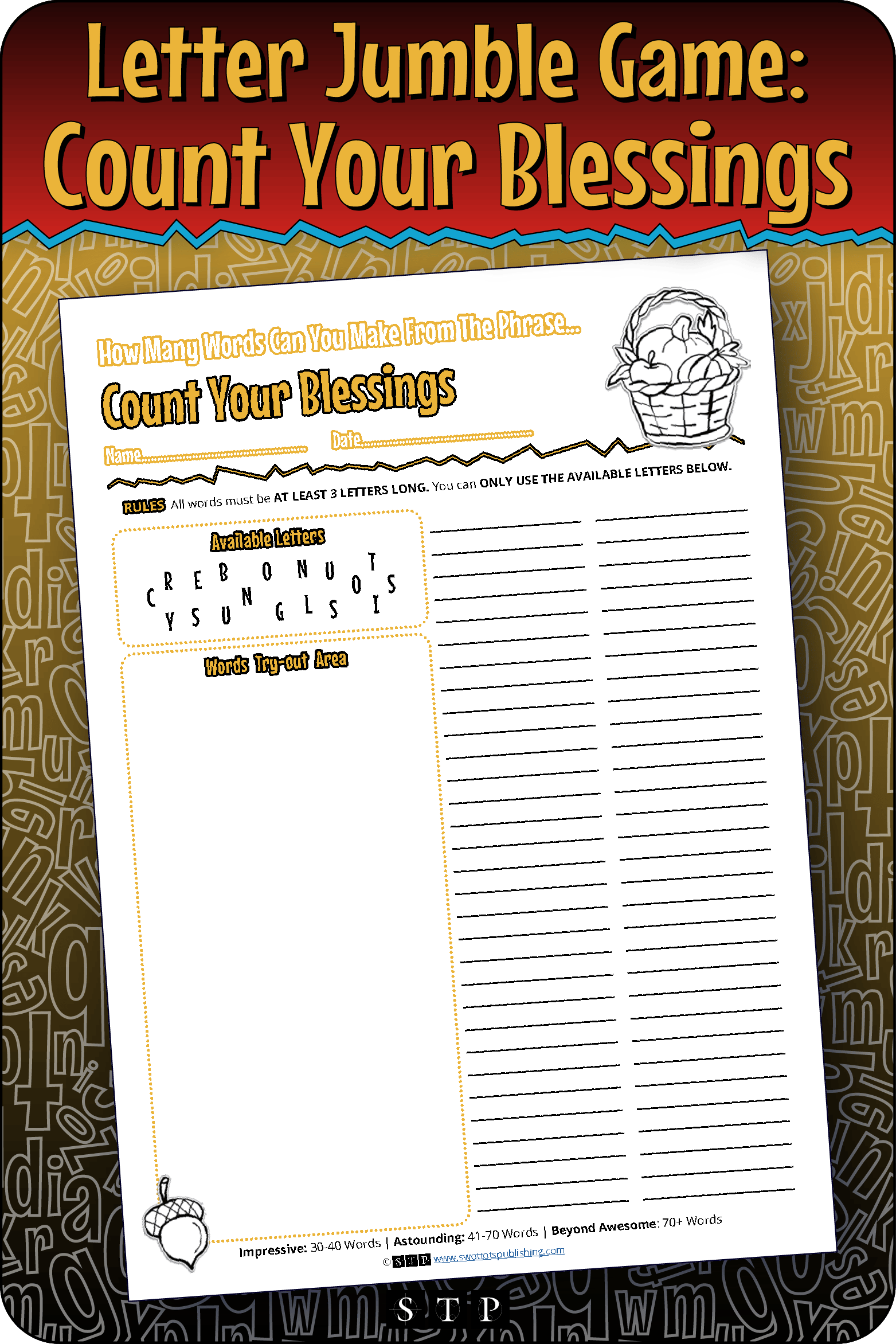
- Making Words from "Christmas" or "Merry Christmas": This can be a fun way to build vocabulary and spelling skills. The aim is not to find a set number of words, but to discover as many as possible using only the letters in the target word(s).
- From "Christmas": You can find words like car, star, arm, sit, art, ram, rim, mass, mast, chart, march, charts, etc.
- From "Merry Christmas": You get even more letters. Think merry, mice, rice, cry, charm, cream, match, reach, ear, my, me, etc.
- The Twelve Days of Christmas is a well-known traditional Christmas carol. It is a cumulative song, which means that each verse adds a new gift to the previous ones. Famously, it starts with: "On the first day of Christmas, my true love sent to me, / a partridge in a pear tree." The complete sequence of gifts is as follows:
- A partridge in a pear tree
- Two turtle doves
- Three French hens
- Four calling birds
- Five gold rings
- Six geese a-laying
- Seven swans a-swimming
- Eight maids a-milking
- Nine ladies dancing
- Ten lords a-leaping
- Eleven pipers piping
- Twelve drummers drumming
Why not challenge your child to see if they can remember all twelve gifts, and in the correct order and quantities?